
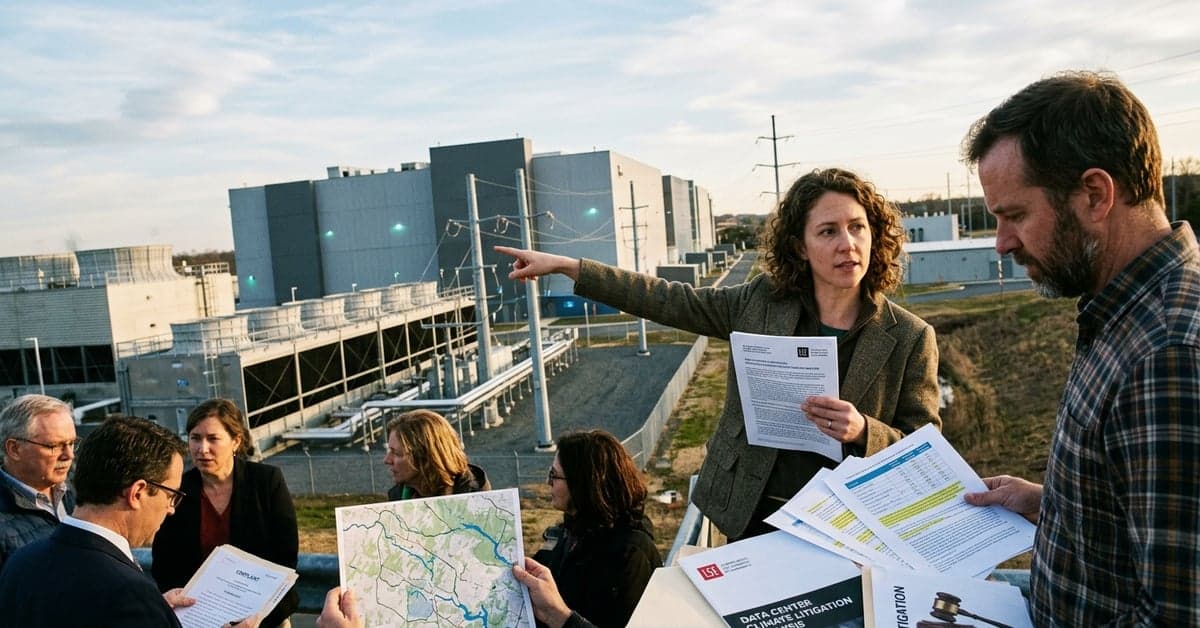
On June 25, 2026, The Guardian reported that data centres are becoming prime targets in climate-related legal cases, citing new analysis from the London School of Economics. The report links lawsuits to energy sources, water consumption, and air pollution tied to the AI buildout. That shift points to a fast-emerging business risk for companies racing to deploy large GPU clusters and the facilities that run them. The trend has a name already: data center climate lawsuits.
What the LSE analysis found about data center climate lawsuits
According to The Guardian, the LSE analysis highlights three flashpoints. First, permitting fights where facilities sit on fossil-heavy grids. Second, disputes over water withdrawals for cooling. Third, complaints about emissions from diesel backup generators and related air quality impacts. Each invites a different legal strategy from community groups, environmental advocates, or regulators.
The shape of these cases fits the broader rise in climate litigation tracked by academic centres. The LSE-affiliated Grantham Research Institute has documented steady growth in climate lawsuits across sectors. Its trendlines help explain why a once obscure permitting fight over a server hall can now draw national attention. Where plaintiffs once focused on oil and gas, the filings are widening to include the digital infrastructure underpinning AI.
Case databases show the scope of this shift. The Sabin Center’s global tracker catalogs thousands of climate cases and has expanded its corporate and infrastructure entries over time. Readers can scan that record at the Climate Change Litigation Database. The growing presence of data centre disputes signals that AI’s footprint is entering the same legal frame as heavy industry.
AI’s growth turns data centres into legal flashpoints
AI training runs are pushing operators to assemble larger clusters and denser racks. Those clusters want megawatts, and sometimes millions of litres of cooling water each day, depending on design and climate. The International Energy Agency warns that electricity demand from data centres, cryptocurrency, and AI could roughly double by 2026, piling pressure on local grids. That projection is detailed in the IEA’s Electricity 2024 outlook.
Water is the other front. Researchers have begun quantifying the water footprint of model training and inference, which connects directly to land-use and permitting questions. One widely cited study on AI’s water use lays out how siting and cooling choices drive that footprint across seasons and regions. The analysis, “Making AI Less Thirsty,” underscores why desert metros or drought-prone basins attract closer scrutiny.
Put together, those stresses are spawning data center climate lawsuits that ask judges and agencies to weigh the public benefits of AI against local costs. The filings often challenge environmental impact statements, emissions modelling, or water rights paperwork. Plaintiffs are betting that fast-moving projects leave procedural gaps. Defendants argue that the benefits of AI justify rapid timelines and that mitigation plans are sound.
How these cases could reshape siting, power, and water
Legal pressure tends to become design pressure. Expect more projects to favour sites with firmed renewable power and clear water access that won’t clash with residential or agricultural needs. That means regions with strong wind and solar pipelines, transmission headroom, and non-potable sources for cooling. It also pushes operators toward heat reuse, dry or hybrid cooling, and battery-backed backup instead of diesel where regulations allow.
Disclosure will tighten too. Power purchase agreements that tout “green” supply will face deeper reviews of timing, curtailment, and transmission losses. Claims about avoided grid emissions will need auditable methods. The EU is already moving in this direction; large facilities face new reporting duties under the updated Energy Efficiency Directive, as set out by the European Commission. Those filings become evidence in any dispute, which raises the bar for accuracy.
Water stewardship plans will need to be public, specific, and monitored. Communities want clarity on sources, seasonal drawdowns, thermal discharges, and reuse. In dry years, courts may ask whether proposed operations conflict with emergency restrictions or habitat protections. Operators that treat and cycle water on-site, or tap reclaimed sources, will face fewer objections and shorter dockets.
Insurers and lenders will price the risk. If permits are likely to be appealed, financing terms will reflect the delay. That can tilt decisions toward jurisdictions with clear siting rules and early community engagement, even if land is pricier. In short, the legal trend can move billions in capital long before a judge rules.
What operators should do before the lawyers arrive
First, build the record. Publish hour-by-hour energy and emissions modelling that matches local grid conditions. Pair new load with new, additional renewable supply, and explain the math in plain language. This reduces room for claims about greenwashing or hidden emissions.
Second, treat water like a licence to operate. Commit to reclaimed or non-potable sources where feasible. Set seasonal caps. Add third-party monitoring with public dashboards. If a drought hits, state the cutback plan in advance.
Third, reconsider backup. Diesel generators are a magnet for air-quality challenges. Where rules permit, lean on batteries for short outages and explore cleaner fuels for longer ones. Document how those choices cut local pollutants, not just carbon.
Fourth, meet communities early. Offer binding community benefit agreements tied to jobs, training, and local infrastructure. Be explicit about traffic, noise, and heat management. Lawsuits often follow surprise; transparency narrows the target.
Finally, audit the claims in marketing and earnings calls. Plaintiffs will quote them. If you tout “water neutral” operations, show the baselines, boundaries, and third-party verifications. Precision beats slogans when disputes turn on a comma in a permit.
Why this matters for AI’s next buildout
The Guardian’s report on June 25, 2026, puts AI infrastructure on the same legal map as pipelines and power plants. The message is simple: the fastest-growing part of computing can no longer count on quiet permits. The rise of data center climate lawsuits is less about stopping AI than forcing it to fit the limits of place and season.
That pressure will shape where AI runs and how it is powered and cooled. Companies that plan for it can still move fast. Those that don’t will move only as fast as the next court calendar. For more on this, see bloomberg.com and nytimes.com.
Related reading: AI in Education • Data Privacy • AI in Society