
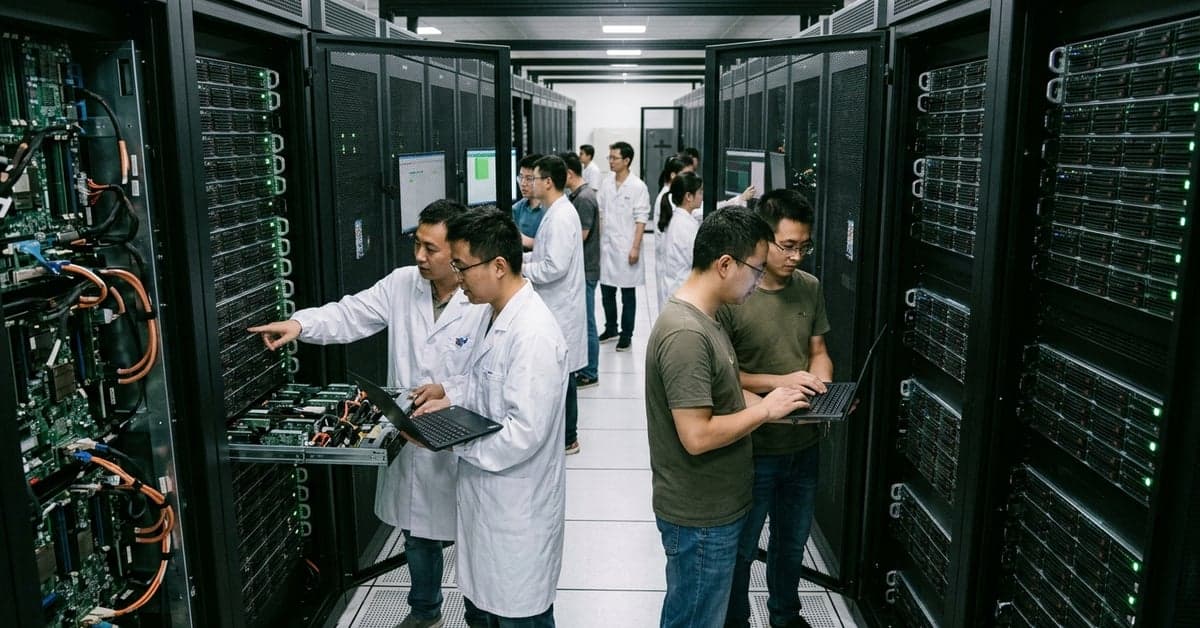
On June 24, 2026, The Guardian reported that a Chinese supercomputer leapfrogged U.S. machines to be ranked the world’s fastest. The Chinese fastest supercomputer now sits atop the global list, a symbolic win with real consequences for where cutting-edge AI models get trained and who sets the pace.
The Top500 project tracks the world’s most powerful systems using the High-Performance Linpack test, which measures how quickly a machine solves dense systems of linear equations. That benchmark crowns bragging rights twice a year and offers a proxy for national compute capacity. Readers can explore the current Top500 list and the Linpack methodology to see how winners are chosen. Linpack, though, is only part of the story for AI.
How the Chinese fastest supercomputer reached No 1
HPC performance is typically tallied in floating-point operations per second. That’s helpful for physics simulations and climate models. AI work looks different. Large model training stresses memory bandwidth, interconnect latency, and software stacks. A system can ace Linpack yet lag on massive multi-node AI training if its networking or memory pipeline chokes under load.
Independent AI benchmarks tell that tale. MLCommons’ MLPerf Training suite, for example, times how fast clusters finish specific deep learning tasks. The fastest entries rely on tuned interconnects, optimized kernels, and careful parallelization. That nuance helps explain why a Linpack No 1 doesn’t always translate to the fastest time-to-train for frontier-scale models, though leaders often overlap.
What elevates this ranking beyond pageantry is what it signals about domestic capability. If China’s top supercomputer can coordinate vast compute at scale, it reduces the need to rely on foreign accelerators for certain workloads. That matters in a year defined by supply constraints and geopolitics.
China’s top supercomputer and the AI compute race
Since 2023, Washington has tightened restrictions on advanced AI chips bound for China, aiming to slow military and dual-use applications. Those curbs, summarized by analysts at the Center for Strategic and International Studies, forced Chinese labs to stretch existing hardware, redesign software stacks, and push domestic silicon. A No 1 ranking suggests that, at least for some classes of compute, those workarounds now scale.
AI progress follows compute. More usable flops and faster interconnects mean cheaper experiments, shorter iteration cycles, and bigger models. If research groups inside China can access time on the No 1 system, they can train models that would have been impractical on fragmented clusters. Access policies matter as much as peak speed. A single machine open to a broad slice of researchers moves the field more than a closed cluster tied to one program.
The Guardian’s headline captures the leaderboard shift. The deeper read is about bargaining power. Countries with credible top-tier compute can recruit talent, set collaboration terms, and bid for industry partnerships. Vendors, meanwhile, follow demand and available power. The Chinese fastest supercomputer adds gravity to that orbit.
Chips, sanctions, and the energy bill
Compute isn’t free. It arrives with a growing electricity tab and cooling challenge. The International Energy Agency estimates data centers’ power use is surging worldwide, pressuring grids and water supplies in some regions. Its latest briefing on data centres and networks outlines scenarios where demand keeps climbing as AI adoption spreads.
That’s where national strategy meets engineering. To keep a machine like the Chinese fastest supercomputer fed, operators need firm capacity, efficient cooling, and often on-site or contracted low-carbon power. Regions that pair abundant energy with streamlined permits are pulling ahead. Those that can’t are watching projects stall. The details—power usage effectiveness, hot-aisle containment, liquid cooling—now sway timelines as much as any chip roadmap.
Sanctions play into this calculus too. If certain accelerators or networking components remain restricted, builders must optimize around what’s available. That pushes more investment into interconnect design, compilation toolchains, and sparsity-aware training. The result could be systems that look different under the hood yet deliver competitive effective throughput on core AI workloads.
What to watch next: benchmarks, access, and research flow
Two numbers will matter in the months ahead. First, the time-to-train for standard models on mixed-scale clusters, as logged by MLPerf and peer-reviewed papers, will show whether the new No 1 translates into real AI speedups. Second, allocation policies and queue times will reveal who can actually use the machine. A fast but exclusive system changes fewer outcomes than a slightly slower one open to many labs.
Energy footprints deserve equal scrutiny. Watch for new power contracts, co-location with generation assets, or shifts to warm-water or direct-to-chip liquid cooling to shave losses. Those choices will determine the operating cost curve. They’ll also shape the environmental debate already building around AI growth.
According to The Guardian on June 24, 2026, the leaderboard flipped. If the Chinese fastest supercomputer stays on top through November’s update, expect capital and talent to follow the signal. For AI, where compute sets the ceiling, that shift could decide who reaches the next rung first—and what the rest of the world pays to keep pace. For more on this, see nytimes.com.
Related reading: AI in Education • Data Privacy • AI in Society