
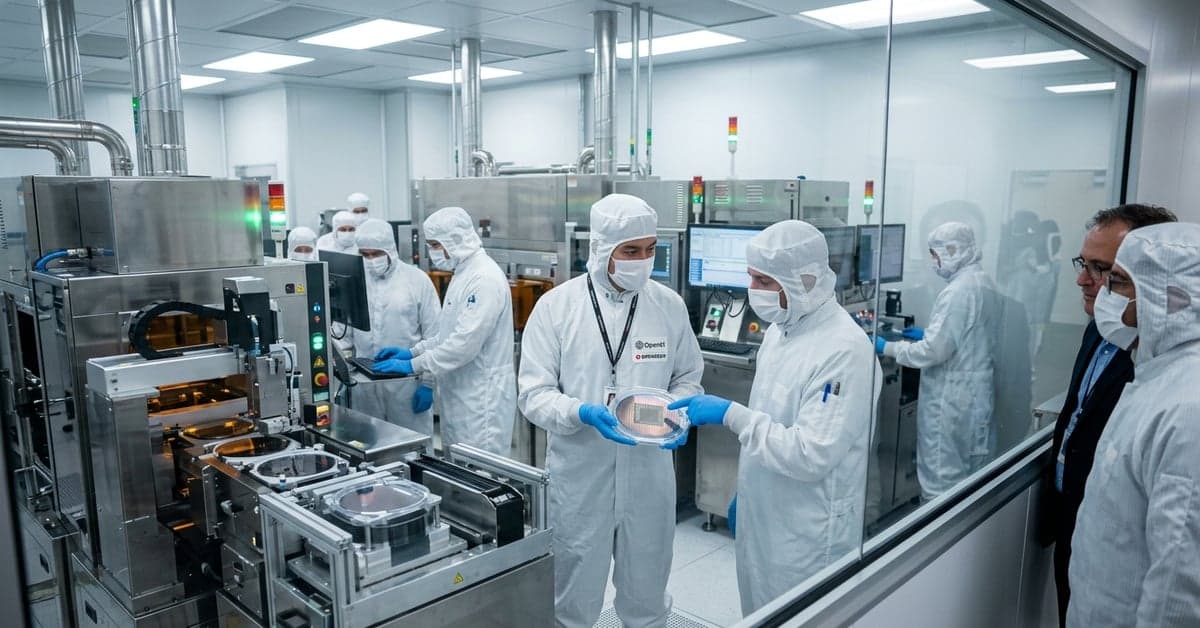
On June 25, 2026, TechCrunch reported that OpenAI unveiled its first OpenAI custom chip, built with Broadcom as its silicon partner. The move puts one of AI’s highest‑consumption customers on a path to control more of its compute destiny, a signal that the center of gravity in AI is tilting from off‑the‑shelf GPUs toward purpose‑built accelerators.
What TechCrunch reported about the OpenAI custom chip
According to TechCrunch, OpenAI introduced a homegrown processor designed with Broadcom. It’s the company’s first public step into custom silicon after years of scaling on Nvidia hardware. The headline detail is the Broadcom tie‑up, which aligns OpenAI with one of the few firms that can ship advanced application‑specific chips at scale.
Beyond who built it, the announcement points to a strategic shift. A bespoke part can be tuned for the kinds of transformer workloads OpenAI runs most, and for the power and networking envelopes its data centers can support. It also offers a path to hedge against supply shocks and spot‑pricing swings that have defined the GPU boom.
Why a custom OpenAI accelerator matters for supply and cost
Control over compute shapes the entire business. If a model lab can trim watts per token on inference, or pack more memory bandwidth near the die, the unit economics of every product improve. That’s the promise behind an OpenAI custom chip, and it’s why hyperscalers have spent years on in‑house parts.
Broadcom brings relevant muscle here. The company’s custom ASIC services are built for clients that need silicon tailored to specific workloads and massive scale, from design through packaging and validation. Its public materials outline those capabilities for high‑performance chips and fabrics (Broadcom). The partnership suggests OpenAI is prioritizing tight co‑design across compute, memory, and networking, rather than swapping in a GPU on a general server board.
This also chips away at concentration risk. Nvidia’s GPUs still set the pace for training and enjoy a powerful software moat in CUDA (Nvidia developer docs). But alternative stacks, from Google’s TPUs to AWS’s Inferentia and Trainium, have proven that targeted accelerators can carry major workloads. Google’s long‑running TPU program shows how custom parts can integrate with a cloud stack and compiler toolchain (Google Cloud).
Policy tailwinds also matter. The push to expand domestic chip capacity and secure advanced packaging has intensified since the CHIPS and Science Act, aimed at bolstering U.S. semiconductor supply chains (White House). A big buyer like OpenAI signaling demand for custom parts supports that ecosystem and may open doors to priority allocation as fabs ramp new nodes and HBM capacity.
What it means for startups building on AI infrastructure
Startups care less about who fabs a die and more about what it changes in access, price, and performance. The first question is where the OpenAI accelerator will live. If it’s kept private for OpenAI’s own services, the effect shows up as faster ChatGPT‑class products, lower latency, and steadier pricing. If it’s exposed through a cloud API or partner, it becomes another tier of capacity founders can target.
Either way, choice expands. Teams have already learned to think in multiple stacks: CUDA for GPUs, XLA for TPUs, and vendor SDKs for other accelerators. A new chip means fresh compiler paths and performance profiles. That nudges engineering planning toward portable graph definitions, modular kernels, and inference services that can route requests by price‑performance, not just availability.
There’s also a hiring tell here. Chip bring‑up and compiler work require a different mix of skills than scaling fleets of GPUs. Expect more demand for engineers who can stitch together runtime layers, quantization strategies, and memory plans tuned to a new ISA. Startups that build tools to abstract those differences—profilers, schedulers, and cost routers—gain leverage as the market fragments.
What to watch next: the software story, pricing, and who follows
Specs will set expectations. Look for details on process node, memory architecture, and networking. Watch for which frameworks the first toolchains support out of the gate, and whether kernels for attention, MoE routing, and KV‑cache management hit parity with mature GPU paths. The presence of a clear migration guide would signal intent to expose capacity beyond internal use.
Pricing will tell you if this changes the game. If OpenAI passes efficiency gains through to API rates, or offers burst access during GPU crunches, startups will have a real incentive to target the new path. If the part is reserved for model training while GPUs handle most inference, the impact will be subtler at first.
Keep an eye on rivals. If more labs announce bespoke accelerators, the market splits into a few large silicon families, each with its own compiler and runtime. That would harden multi‑target development as a default, much like mobile teams learned to ship for iOS and Android from day one.
The headline is clear: by stepping into chips with Broadcom, OpenAI is betting that control over compute is now core R&D, not a procurement line item. For founders, the signal is to build for a multi‑accelerator world where routing, portability, and cost awareness matter as much as raw speed. However the roadmap lands, an OpenAI custom chip makes that shift hard to ignore. For more on this, see openai.com and developer.nvidia.com.