
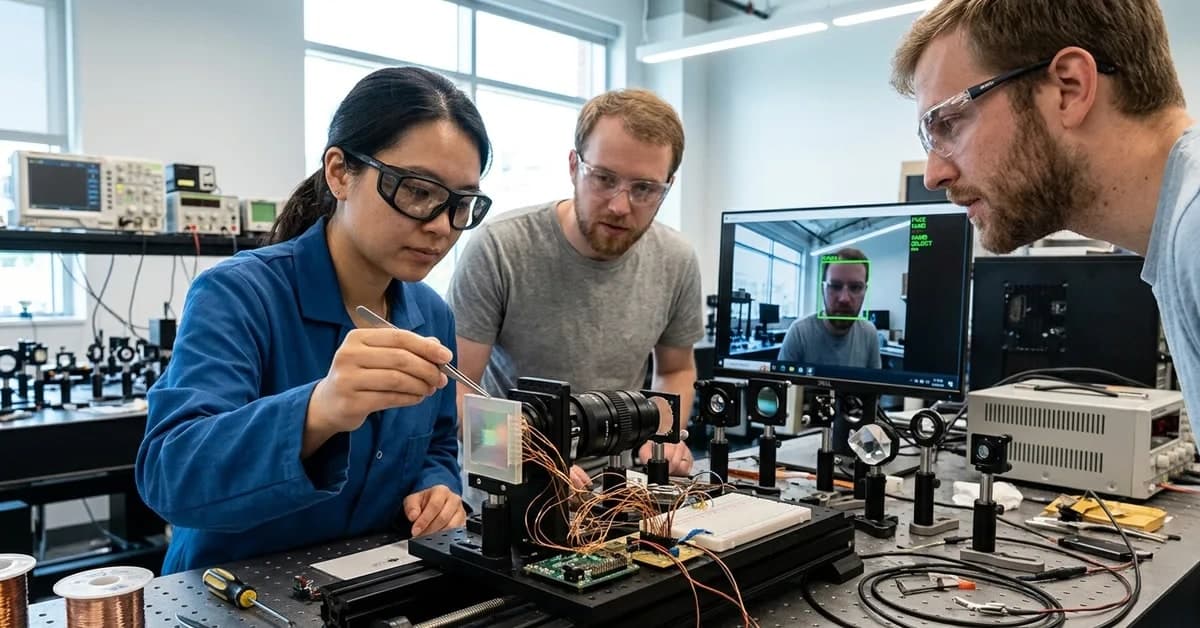
On June 17, 2026, Nature highlighted a prototype vision system that embeds core computer-vision operations into an optical metasurface, enabling real-time perception on the sensor itself. The News & Views piece argues this approach could deliver low-energy, on-device intelligence by shifting work out of silicon and into light. It frames a concrete path for machine learning beyond the usual chip race.
How optical metasurfaces push machine learning to the sensor
According to Nature’s machine learning coverage on June 17, 2026, researchers built a general-purpose AI vision system by encoding the fundamentals of core computer-vision tasks into a planar, light-manipulating layer. That layer is an optical metasurface — a patterned sheet that bends and filters light through subwavelength structures before it reaches downstream electronics. By baking these primitives into the optics, the sensor receives a preprocessed signal that is faster to interpret and cheaper to compute.
The idea turns light into the first compute stage. A metasurface can perform operations such as filtering or combining spatial frequencies as photons pass through, which is why it draws interest for vision. For readers new to the concept, metasurfaces are engineered interfaces that shape wavefronts with fine-grained structures, while optical computing aims to carry out math with light rather than electrons. Nature reports that the prototype delivered accurate, real-time perception across varied tasks, suggesting a route to sensor-level intelligence that leans on physics first, then silicon.
Why this physics-first path matters for edge AI
Edge devices live under tight power and bandwidth budgets. Cameras flood systems with pixels, and moving that data often costs more energy than the math itself. If optics do the heavy lifting early, systems transmit and process far fewer bits. That helps phones, drones, AR glasses, and industrial nodes where battery life and heat are hard limits. It also cuts latency because the first stage of perception happens at the focal plane, not a few memory copies later.
This approach aligns with the broader push to keep more intelligence on the device. Edge AI reduces reliance on networks, preserves privacy by keeping raw imagery local, and avoids unpredictable round trips to the cloud. If a metasurface front end can deliver stable, task-agnostic preprocessing, smaller downstream networks can do the rest. That is a different optimization target than throwing a larger accelerator at every workload.
What the prototype shows — and what we still need to see
Nature’s account says the device achieved accurate, real-time results across diverse tasks. That’s meaningful because most optical systems have excelled at narrow, fixed functions. A general-purpose front end suggests breadth rather than a single trick. It also hints at lower energy per frame, since the hardest parts happen for “free” in the light path.
But “general-purpose” needs careful testing. How broadly can the optical layer support tasks beyond the initial menu? Can it be tuned without swapping hardware? Programmability is the key constraint for any optical system that aims to play alongside modern machine learning. Calibration drift, temperature stability, and manufacturing tolerances also matter; nanostructured surfaces are sensitive to process variation. Without those details, it’s hard to project real-world yields or maintenance needs.
There is also the question of integration. Many image sensors, lenses, and packaging steps are standardized around CMOS lines. A metasurface that must sit precisely in the stack faces alignment and durability questions. If the optical stage becomes part of a consumer camera module, repairability and drop resistance enter the picture. None of these are showstoppers, but they set the milestones that turn a clean lab demo into a reliable product.
The next tests for sensor‑level machine learning
This prototype invites a new kind of benchmark. Instead of rating chips alone, labs could compare entire vision stacks: optics plus sensor plus inference. The baseline should include today’s best on-device accelerators and efficient models. If a metasurface halves the data volume into the pipeline, do we see proportional gains in battery life, thermal headroom, or frame rate? Standardized, side-by-side trials would make the case clear.
Competition is healthy here. Event cameras, specialized NPUs, and clever compression all aim to shrink the same bottlenecks. Optical preprocessing might pair with any of them. One plausible path is hybrid: let the metasurface perform domain-general filtering and transforms, then hand compact features to a small neural network tuned for a particular application. That puts physics where it excels and reserves learning for the residue a fixed optic can’t cover.
Policy and privacy angles are straightforward. If raw scenes never leave the device and only features flow downstream, systems expose less sensitive data. That helps compliance in places where data transfer rules are strict. It also dovetails with the trend toward more capable personal devices that do meaningful analysis while offline.
What Nature’s report signals for the next wave of AI vision
By calling this metasurface approach general-purpose and showing real-time results, Nature’s June 17, 2026 coverage sets a higher bar for optical front ends. The evidence points to a credible niche in products that need long battery life and instant response. If future studies quantify energy per inference and image quality across lighting conditions, buyers and builders will have the data they need.
The larger point is direction. We’ve pushed silicon hard; the next wins may start before electrons move at all. If optical preprocessing becomes standard on camera modules, machine learning stacks will be rewired around smaller models, leaner memory traffic, and simpler post-processing. That outcome would change how phones, wearables, and robots budget power — and where they spend it.
For now, the prototype shows that physics and AI can share the load. As more details land in peer-reviewed reports, and as manufacturing partners weigh in, we’ll learn whether this design scales beyond the lab. If it does, the first apps to benefit will be the ones where milliseconds and milliwatts rule — the perfect proving ground for machine learning done at the speed of light. For more on this, see bloomberg.com and nytimes.com.