
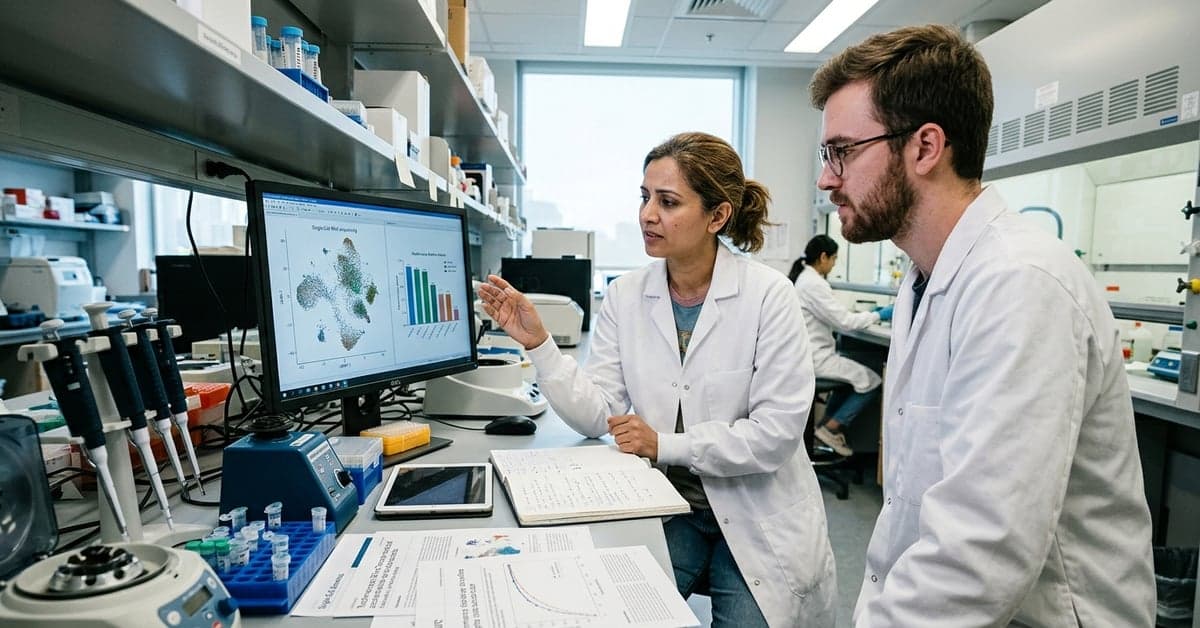
What Nature says about single-cell AI scaling
On June 9, 2026, Nature reported that making training datasets for single-cell foundation models ever larger brings little extra performance beyond a set point. The News & Views article assessed how size and diversity affect transcriptomic AI systems trained on tens of millions of cells, and found returns that flatten as volume grows. The message cuts against a simple “more is better” playbook and points to a shift in where time and money should go.
Single-cell datasets aim to capture gene expression in individual cells across tissues, organisms, and conditions. They power models that try to generalize across labs and studies. According to Nature’s analysis, when collections swell without meaningfully expanding biological coverage, accuracy barely moves. That’s a costly way to stand still, and it reframes how teams should think about single-cell AI scaling.
Why the plateau matters for transcriptomic AI scaling
Sequencing cells at scale is expensive. So is training large models on them. If gains stall past a threshold, lab budgets, grants, and cloud credits are better spent on smarter sampling and evaluation than on brute-force accumulation. Nature’s piece argues the main constraint isn’t just terabytes, it’s what those terabytes represent.
In practice, that means sweeping in underrepresented cell types, rare states, and varied protocols rather than adding yet another batch of similar cells. The finding also challenges a direct transfer of language-model “scaling laws” into biology. Classic results in AI show smooth improvements as data and compute rise together; see the 2020 study on neural scaling by Kaplan and colleagues on arXiv. Nature’s account suggests the curve in single-cell work bends much earlier unless diversity broadens alongside size.
Data diversity beats sheer volume in biology
What moves the needle is biological coverage: different tissues, stages, perturbations, species, and lab pipelines. That mix helps models learn stable signals instead of overfitting to dominant cohorts. The Human Cell Atlas project shows how broad, well-annotated collections can anchor generalization. Nature’s article points to the same principle: diversity lifts the ceiling more than piling on near-duplicates.
This matters for benchmarking too. If test sets mirror training distributions too closely, performance looks better than it is. Gaps only appear when models meet new tissues or protocols. Nature’s take pushes for tougher, cross-lab evaluations that reflect the messy reality of future applications. That is where single-cell AI scaling will be judged—on new ground, not on familiar terrain.
How labs and vendors can respond
- Rebalance spending toward targeted curation and richer metadata, rather than bulk collection of similar cells.
- Adopt benchmarks that stress out-of-distribution generalization across tissues, perturbations, and labs.
- Co-design models with biological priors and quality controls that reduce dependence on sheer volume.
- Pool resources through consortia and shared evaluation suites to compare methods on equal footing.
There’s a procurement angle too. Cloud budgets should track marginal gains, not total terabytes processed. Sequencing plans should ask what new biology each batch adds. For platform vendors, the pitch shifts from petabytes to coverage: show that new data closes blind spots. Background explainers, such as the Broad Institute’s overview of single-cell genomics, underline how uneven real-world data can be. Nature’s assessment says the fix is to embrace that unevenness on purpose.
What we’ll learn next
Two tests will tell whether this pattern holds. First, do models trained on smaller but more varied sets beat those trained on larger, homogeneous ones when faced with truly novel tissues? Second, can better metadata and standardization raise the plateau without exploding costs? According to Nature, early signs point to yes—diversity pays off where volume alone stalls.
The bigger takeaway is strategic. Treat data like a portfolio, not a pile. Put each new sample to work broadening the biology your model sees. If that discipline spreads, single-cell AI scaling won’t mean chasing bigger numbers. It will mean chasing better coverage, clearer evaluations, and sturdier performance when the next dataset looks nothing like the last. For more on this, see reuters.com and nytimes.com.
Related reading: Federated Learning • Quantization • Machine Learning