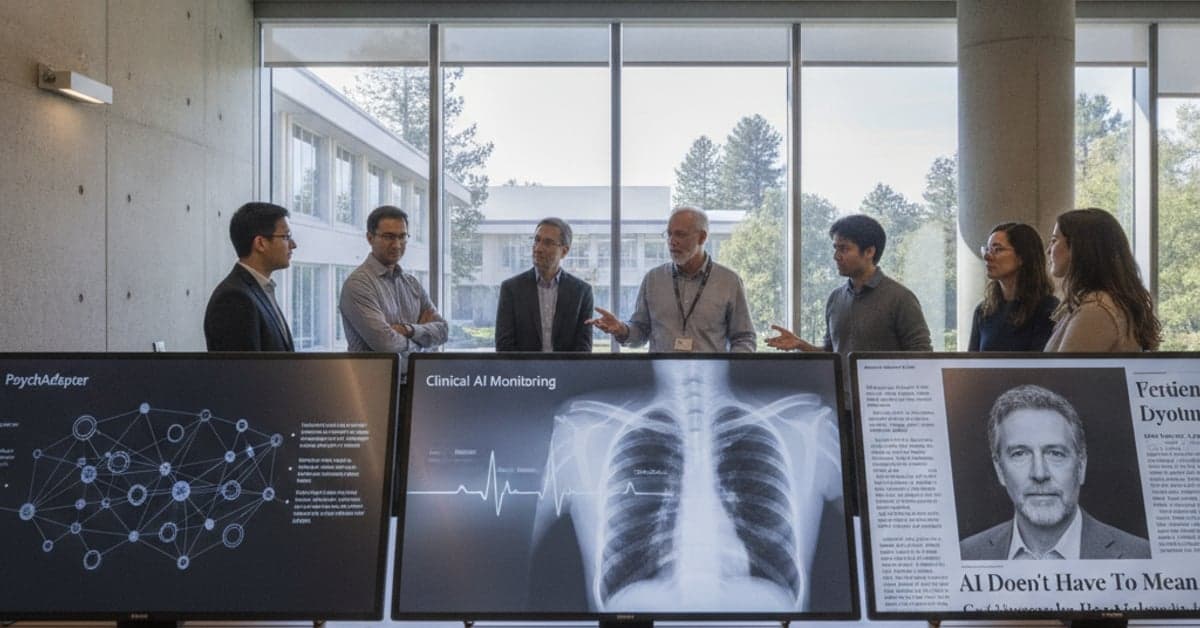
Stanford HAI’s homepage now foregrounds three signals at once: a new method for agent personality control called PsychAdapter, a policy brief on real‑time monitoring of radiology AI, and Erik Brynjolfsson’s New York Times argument that “A.I. Doesn’t Have To Mean Layoffs” (Stanford HAI; New York Times). Read together, they sketch a pragmatic thesis—raise output through augmentation while tightening oversight—an institutional path toward AI productivity without layoffs.
What Stanford HAI is signaling on AI productivity
The page curation reads like an editorial stance. According to Stanford HAI, its news feature introduces PsychAdapter, which “lets researchers dial in on personality traits, age, and mental health characteristics to generate text that sounds like real individuals.” That research points to agents that align better with domain needs—customer support with tone constraints, tutoring with age‑appropriate voice, or simulation training with consistent personas—classic augmentation use cases. In that framing, AI productivity without layoffs comes from targeted assistive tools that fit into workflows rather than replacing them wholesale.
The same page boosts a media mention that underscores the jobs angle. Director of the Stanford Digital Economy Lab and HAI senior fellow Erik Brynjolfsson argues that firms can choose redesign over redundancy, focusing AI on task reallocation and product quality, not headcount cuts (New York Times; see also the Stanford Digital Economy Lab). It’s a managerial agenda as much as a technical one: pair new tooling with training, measurement, and incentives that reward augmented output.
The research bet: personality-tuned agents and job-safe automation
PsychAdapter, highlighted by Stanford HAI, hints at a next phase of applied AI: control knobs for behavior, not just accuracy. Personality conditioning changes how answers land for humans. A health coach that sounds supportive keeps patients engaged; a collections agent that stays calm reduces churn. That is where productivity gains often show up—retention, compliance, cycle time—rather than raw headcount. Framed this way, AI productivity without layoffs relies on better human outcomes that compound over quarters.
There’s also a governance upside. Personality control gives teams limits they can audit. If an agent must sound neutral, the spec is testable. That turns “soft” behavior into something engineering and risk teams can inspect. For operators, controllability can be the difference between a tool that scales and a pilot that stalls.
Guardrails in healthcare: clinical AI monitoring as the counterweight
The homepage pairs that optimism with a sober take from clinical settings. A Stanford HAI policy brief—titled “Operationalizing Real‑Time Monitoring of Clinical AI,” by Zhongnan Fang, Lina Cheuy, Hye Sun Na, Akshay Chaudhari, and David B. Larson—details how continuous oversight can close gaps in radiological tools. It argues for monitoring pipelines that track data drift, performance drops, and alert fatigue in live deployments (Stanford HAI). The logic is simple: if a model can shift after release, oversight must shift from annual audits to always‑on telemetry.
That push aligns with regulators’ steady drumbeat on post‑market controls for learning systems. The U.S. Food and Drug Administration has outlined expectations for lifecycle management of AI/ML‑enabled medical devices, including change control plans and postmarket monitoring (FDA guidance). In practice, tying model behavior to operational dashboards is how hospitals keep trust. And it’s how leaders can defend investments that promise AI productivity without layoffs—in healthcare, productivity often means faster reads and fewer repeats, not fewer radiologists.
Why AI productivity without layoffs is plausible
The signals on Stanford HAI’s front page fit a playbook that has worked in prior tech shifts. Productivity gains came from redesigning tasks around new tools—spreadsheets, search, code repositories—while jobs evolved. The throughline is deliberate augmentation. Personality‑tuned agents can improve the human‑facing parts of work; real‑time monitoring keeps high‑stakes systems from drifting into harm. The first raises value; the second preserves trust.
Managers will still need to do the hard parts. Measure quality, not just speed. Share the gains with workers who adopt the tools. Build feedback loops so frontline staff can flag failures before customers do. Those choices decide whether AI means bigger pies or just thinner slices. The Stanford HAI curation suggests the institution is staking out the bigger‑pie path—and offering research and policy scaffolding to make it executable.
What changes next for teams
Expect more specificity in AI pilots. Rather than “add a chatbot,” teams will define persona targets, response constraints, and escalation rules. They will also budget for monitoring from day one, especially in regulated lines of business. Companies chasing AI productivity without layoffs will brief boards on two tracks: customer‑facing wins from better‑behaved agents, and safeguards that keep systems within risk tolerances.
The homepage snapshot isn’t a manifesto, but it is a direction. If the balance holds—controllable agents on the front end, continuous oversight on the back end—the promise of AI productivity without layoffs looks less like rhetoric and more like a plan.