
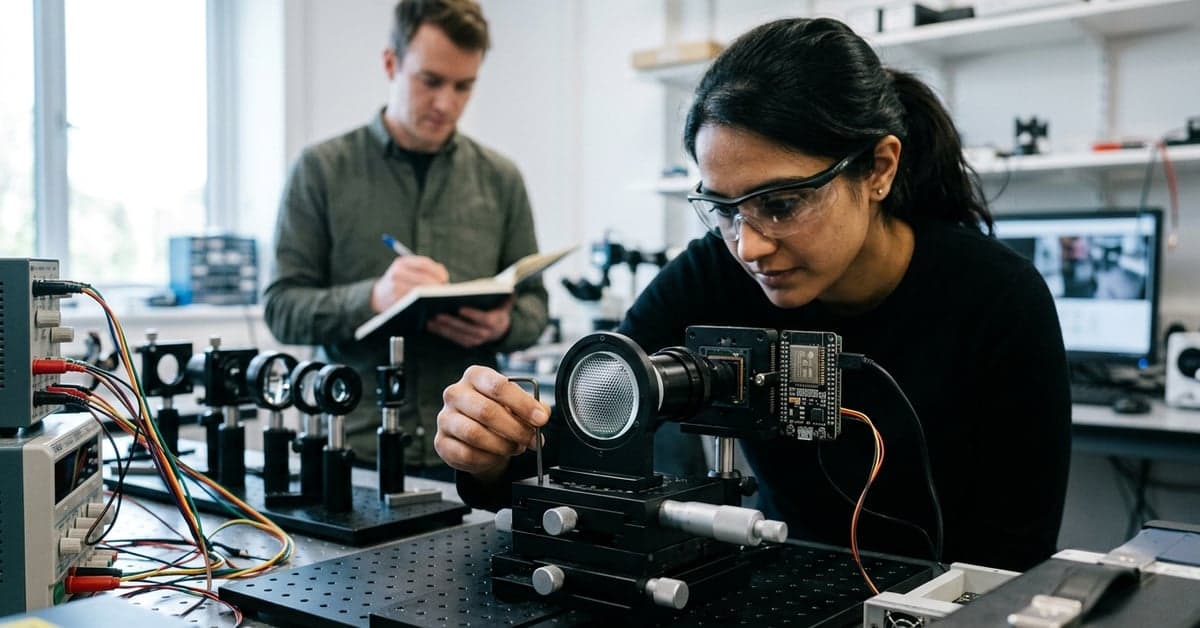
On June 17, 2026, Nature highlighted a prototype vision system that bakes core computer-vision operations into an optical metasurface, aiming for real-time, low-power perception at the edge. This machine learning update points to a path where light does part of the work before a chip lifts a finger.
Nature’s News & Views describes a general-purpose artificial-intelligence vision system embedded in a planar, light-manipulating material. The claim: accurate, on-device perception across diverse tasks with less energy draw than conventional pipelines, which lean on digital convolutions and memory-heavy shuttling of pixels.
How an optical metasurface does the math
According to Nature’s machine–learning coverage, the prototype integrates the “fundamentals” of common vision operators into a single optical layer. A metasurface is a patterned film that bends and filters light with subwavelength features. By shaping wavefronts before photons hit the sensor, it offloads steps usually handled by a processor. For background on metasurfaces, see reference material.
Classic pipelines rely on convolutional layers, pooling, and non-linearities that grind through multiply–accumulate operations. Those steps dominated early CNN designs and still sit at the heart of modern models. The metasurface approach mimics parts of that stack in physics. Incoming light is preconditioned so downstream electronics face a simpler job, with fewer memory moves and fewer digital operations.
The prototype described by Nature is pitched as “general-purpose.” That’s a strong claim in optics, where devices often excel at a narrow transform. The authors say it performs consistently across tasks, which suggests the optical pattern encodes a blend of operators that are broadly useful. The bet is clear: compress useful structure up front, then let a leaner network finish the job.
Why this machine learning update matters for edge vision
Power and bandwidth are the choke points for cameras in phones, robots, and wearables. Every pixel you shuttle to DRAM costs energy. Every frame you ship to the cloud adds latency and privacy risk. An optical front end that reduces compute and memory traffic before the first readout tackles both problems at once. That is the core significance of this machine learning update in Nature’s write-up.
Edge systems—think AR glasses, home security, or factory inspection—win when perception stays local. Edge computing improves responsiveness and keeps raw images on the device. If a metasurface can shave the bulk of early-layer work, the remaining digital pipeline can run on a smaller accelerator or even a microcontroller. Fewer joules per inference means more features within a fixed battery budget, or longer battery life at the same feature set.
There’s also a sensing angle. Some optical patterns can suppress nuisances—glare, defocus, or motion blur—by design. If the physics trims those artifacts at capture, the network trains on cleaner features and may need fewer parameters. That could lower the bar for deploying capable vision on tiny edge hardware.
What this ML update can’t answer yet
“General-purpose” often hides a trade-off: flexibility versus specialization. Fixed metasurfaces are hard to reprogram once fabricated. Reconfigurable optics exist, but they add bulk, cost, or control complexity. The Nature summary doesn’t detail how widely the prototype spans tasks, or how it adapts to distribution shift. Those are open questions that a one-off demo can’t close.
Calibration and manufacturing variability also loom. Subwavelength patterns demand tight tolerances. Temperature, illumination spectra, and sensor alignment can nudge performance. A real product must survive those swings and pass repeatability tests. The path from lab optics to a rugged module is long, even if the physics checks out.
It’s worth comparing to other sensor-first ideas. Event cameras, for example, detect brightness changes instead of full frames, slashing data rates by design. They excel in fast motion and tight power budgets, as explained in technical overviews. The metasurface approach is different: rather than change what gets sensed, it reshapes incoming light to precompute useful transforms. Both strategies attack the same bottlenecks—bandwidth and energy—from different sides.
What to watch next as photonics meets AI
Three milestones will tell us if this line of work can scale. First, integration with commodity sensors and packaging that fits phone-class modules. Second, evidence of consistent gains on public benchmarks across varied lighting and scenes. Third, a software stack that treats the optics as part of the model, so training and inference co-design the layer in front of the lens.
Even if optics shoulder more of the load, digital stays in the loop. Training will still run on GPUs, and many tasks will need learnable parameters behind the sensor. The opportunity is a hybrid stack: physics handles the costly, early transforms; a small network refines the result; the whole system is trained end-to-end with the optical layer modeled in differentiable form. If vendors can ship that co-design in toolchains developers already use, adoption gets easier.
Expect this topic to intersect with photonic accelerators that perform matrix math in waveguides. Those chips chase throughput more than sensing. A metasurface front end pairs naturally with them: compress and filter at capture, then let photonics race through what remains. The winning recipe will be whichever combination clears power, size, and cost limits without breaking developer workflows.
Nature’s June 17, 2026 story marks a quiet reset in how we think about vision stacks: move the first layers into light, and let silicon do less. If follow-on papers confirm the prototype’s task breadth and energy savings, this machine learning update will matter well beyond a single demo. Phones, glasses, and factory cameras are the near-term testbeds. The sooner results land in public benchmarks, the faster we’ll know where the physics pays off—and where it doesn’t. For more on this, see bloomberg.com and nytimes.com.